North Georgia On My Mind: In search of fall splendor in Atlanta's backyard

I’d made a wrong turn somewhere between Nimblewood Church Road and the 3000 foot ridge where Windy Stair Gap Road crests the Appalachian Trail. I had an increasingly bad feeling about the journey from the moment I began to reluctantly ascend the rutted, pitted and stone strewn path in my woefully inadequate two-wheel drive sedan. Approximately 3 miles later, with no place to turn around, and now fully committed to the climb, I didn’t feel any better.
“I don’t know if I smell a skunk or if that’s my car engine,” I said with a hint of anxiety to Danny, who was in the passengers seat busily lacing up an ankle brace he typically reserves for our weekly soccer match.
“Neither. It’s these ankle braces. They really stink,” he replied, now slipping on one of his hiking boots in preparation for the first of our three consecutive day hikes in North Georgia’s Chattahoochee National Forest.
Often overlooked and neglected as a premier Appalachian wilderness in favor of better known destinations in Tennessee and North Carolina, the 750,000 plus acre Chattahoochee National Forest is home to several state parks, all just a stones throw from Atlanta. Craving some fall foliage and challenging mountain treks, Danny and I embarked on a 3-day road trip that would take us to 3 of the 7 Georgia state parks that call the Chattahoochee home.
Our first hike was supposed to be 9 miles round trip, featuring a 4.5-mile ascent to the official start of the Appalachian Trail at Springer Mountain, followed by a descent of equal distance, back down into the valley from which we came.
However, at the 5-mile mark on Windy Stair Gap Road, right where my directions were indicating that we should find a trout stream and a trailhead in a lush valley, my car was emerging onto a clearing atop a mountain saddle that separated two high, forested ridges. When I finally parked the car and relieved the engine, it was practically straddling the Appalachian Trail.
No more than 20 yards from my car, there was a plaque, though not the one I’d hope to encounter that day upon reaching the start of the Appalachian Trail. Instead of the weathered turquoise bronze one featuring a hiker, one foot forward, head up, hands on his pack straps, poised to embark on his journey to Maine, this one memorialized a 1968 plane crash that had killed 4 people.
“Great, another ominous sign,” I thought as I scanned our surroundings. As I stood there, a steel gray blanket of low-lying cloud cover was gradually enveloping the high mountain ridge.
“Well, we came to hike the Appalachian Trail,” I said to Danny, “so let’s make the most of it and hike what we can.”
The surrounding gray brought with it chilly wind and what little fall color was left at this altitude, was muted by the encroaching weather.
We started up an incline on the Appalachian Trail that was no more than 10 feet from my car, heading northeast from a battered wooden sign that read: Nimblewood Gap.
Despite the lack of bright reds, oranges, and yellows that I’d hoped would still be in the trees, fallen leaves of every color spotted the ground, and in some places, practically paved the trail before us. We might’ve missed the color here by only a week.
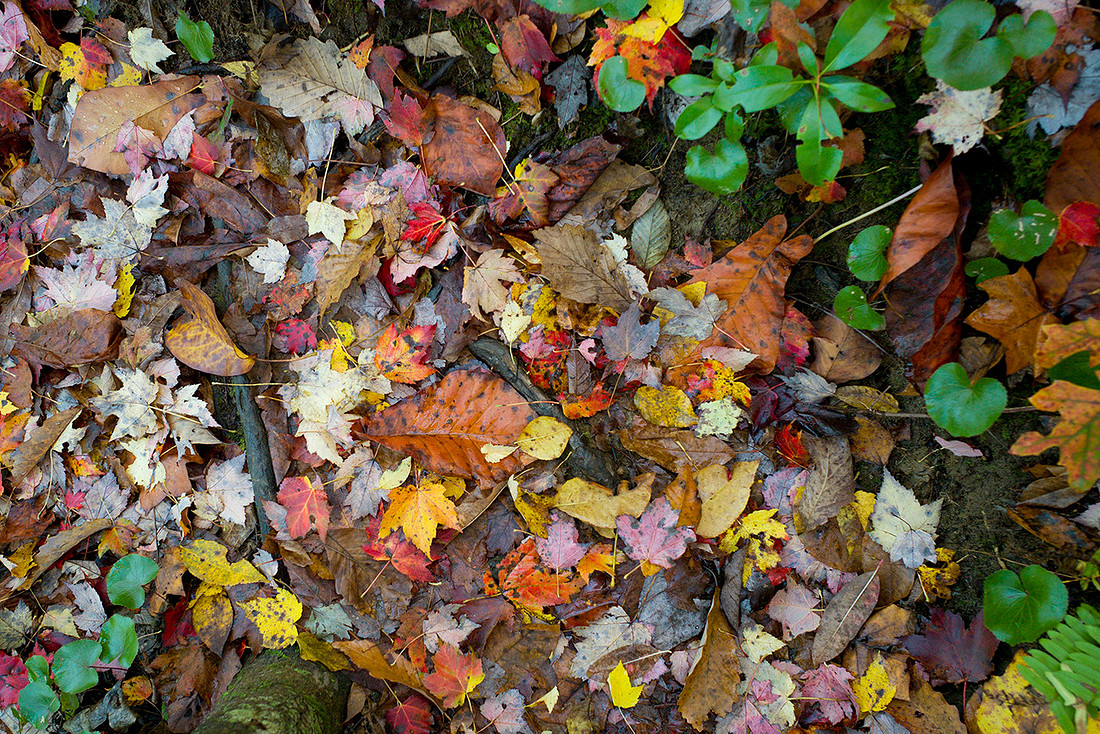
 The trail at this elevation had leveled out, meandering its way below the spine of a mountain ridge, climbing over outcroppings of rocks and boulders, sidestepping trees whose bases were covered with a bright green fungus, and cutting between meadows of ferns now brittle and yellowed.
Danny and I were both silent for the most part, each lost in whatever mental musings the serenity and beauty of a high mountain landscape provokes. Regardless of weather and conditions, I can always count on a mountain hike to calm me and to set my mind at ease.
The remainder of the day would take us on a beautiful drive along the southern outskirts of the Chattahoochee, in route to the forest’s northeastern corner, where we hoped to find better weather as well as a proper trailhead.
All told, we hiked a leisurely 5 miles on the Appalachian Trail that morning and early afternoon. It wasn’t the 9-miler that we’d planned, but it proved to be a satisfying warm up for the days ahead.
The descending gray that we’d encountered on the Appalachian Trail pursued us eastward, across the Chattahoochee National Forest, developing into a small cold front that pushed through overnight. It brought with it, nearly 8 hours of relentless rain and wind that whipped through the mountaintop campground at Georgia’s Black Rock Mountain State Park. In my broken sleep, I could hear the constant metallic pinging of debris pelting my car. Thoughts of it having a brand new peanut textured exterior come morning didn’t help me get to sleep any faster.
There was no sunrise on day two as the last barrage of Mother Nature’s assault persisted until dawn. This delayed us in setting out on the renowned Edmond’s Backcountry Trail, a challenging 7-mile loop that rates as one of the premier treks in Georgia.
When we did set off at mid-morning, one of the clearest, bluest skies I’d ever seen was forming overhead. Spotty cloud remnants of the overnight front were rapidly dissolving into the steadily increasing abyss of an endless, inverted sea. Below, in the void of humidity and cloud cover that dominated the previous day, a dry coolness took its place. By every measure, day two was shaping up to be perfect for a long walk in the woods.
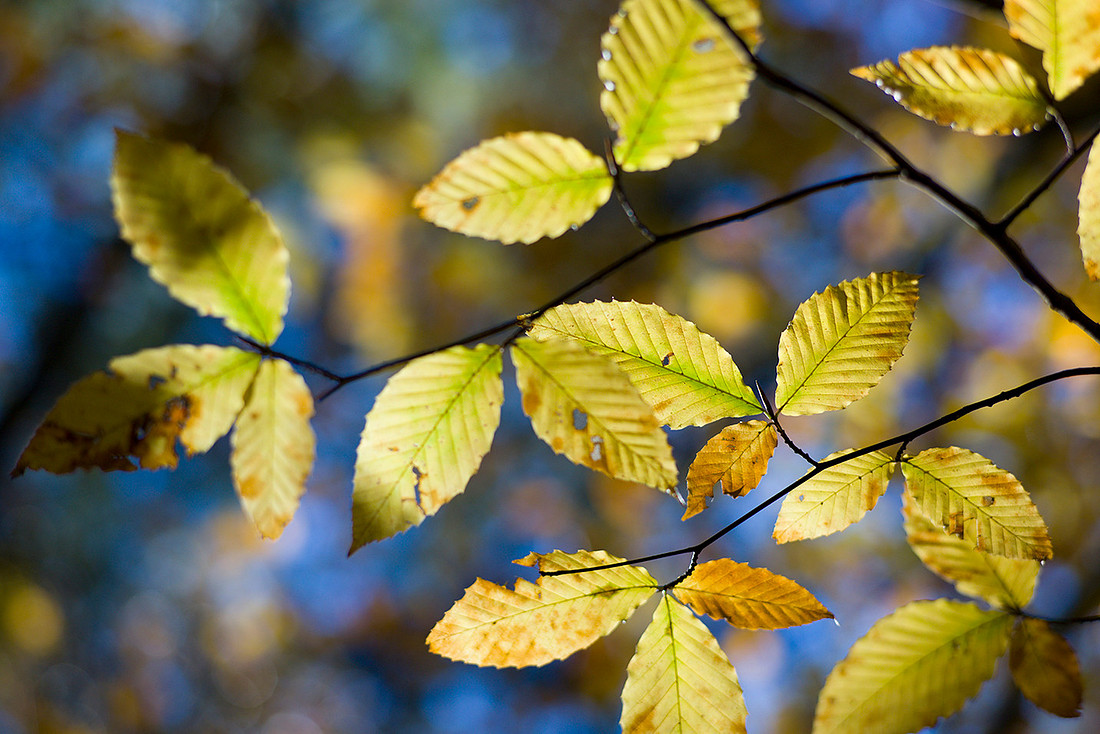 Lower elevations along Edmond’s Backcountry Trail are vastly different from the higher elevations, and it is here that the trail skirts around a picturesque mountain lake, meandering through dense, green vegetation, with a lot of tangled roots, reminding me of southern Florida mangroves more than Appalachian fauna.
Within these relatively lush sections of the trail, we crossed a series of bridges that spanned tumbling mountain creeks that fed into the lake, the mangrove-like fauna forming a cool, moist labyrinth that the high sun couldn’t penetrate. The slightly sweet smell of fresh water mixed with damp soil dominated. With the steadily increasing roar of water running parallel to our ascent, the natural tunnel suddenly opened up to reveal a clearing and a broad 10-foot tall waterfall.
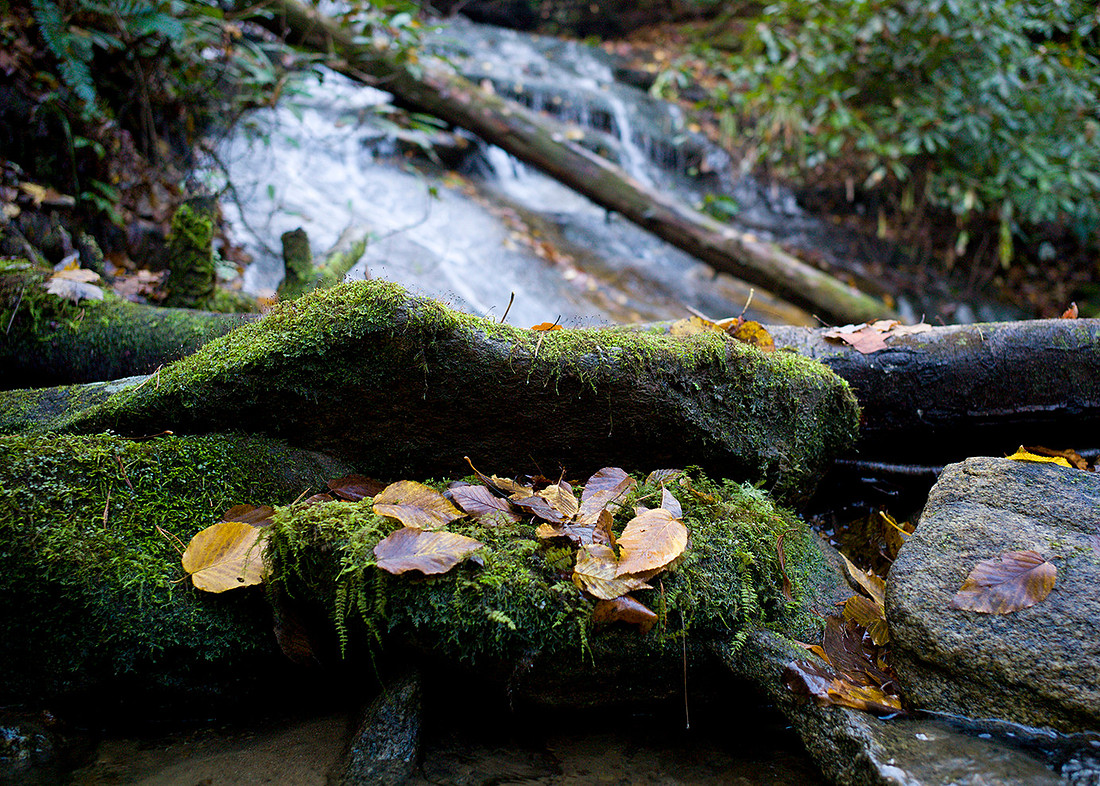
Ascending from the damp valleys, we climbed a series of steep switchbacks, the surrounding landscape changing abruptly into one where light and dryness prevailed. Now, rising from a blanket of fallen, pale yellow and brown leaves, were branchless trees with color remaining only at their tips, as if oversized matchsticks were stuck in the ground, their red tips pointed toward the sky.
We knew we were fast approaching Edmond’s big reveal, the payoff for the sweat and effort we’d put in so far. Approaching the top of a high mountain ridge, the sparse matchstick forest terrain changed again as abruptly as it had between the valley depths and the mid sections. Up here there was a dense hardwood ridgeline with oaks and stouter trees, thick green underbrush and patches of exposed granite.
Then, rounding one final woodsy bend, the view opened up like drapes being pulled back from an expansive window. A trail of bedrock dropped several feet and led to a wide expanse of barren, sloping stone that gradually steepened until it fell off toward a canopy of forest that descended precipitously to the valley below. We'd reached the terminus of the mountain ridge we’d been following.
Spread out before us, was a stunning view of a farm and pasture-filled valley. A quilt of green and brown earthen patchwork was stitched together by country roads and trees of a koleidoscope of hues. Chapels and homesteads dotted the landscape before an endlessly undulating vista of mountains stretched to the horizon beyond.
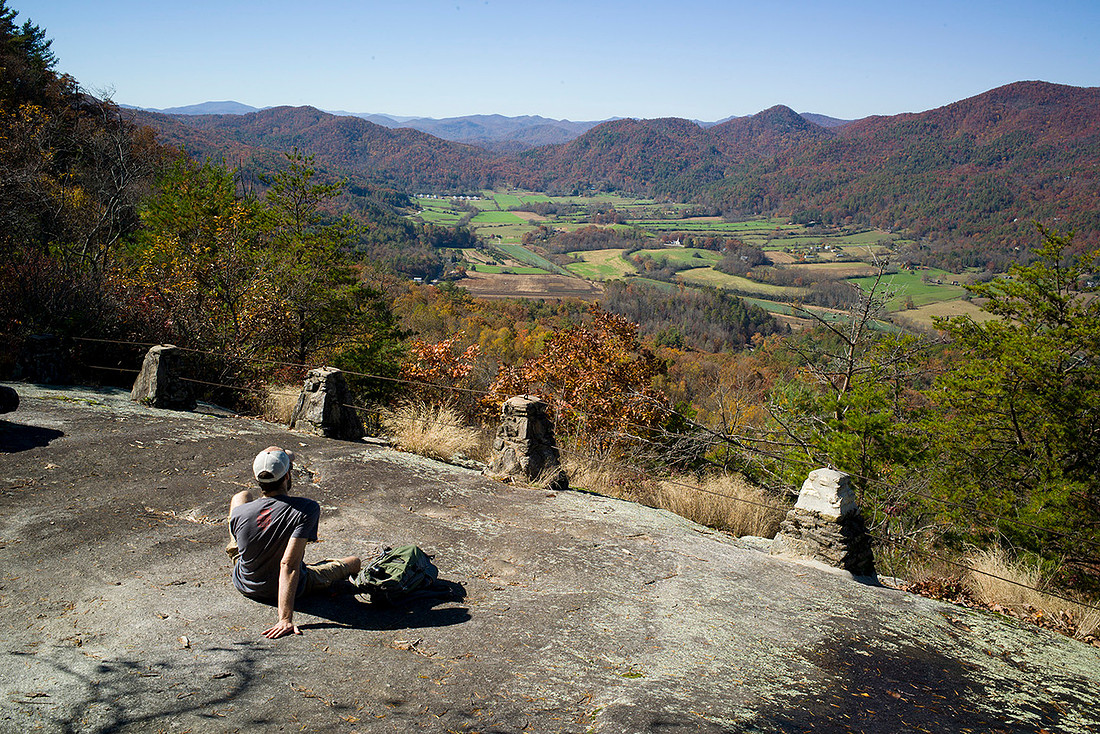
I’d found my fall.
Only 80 miles as the crow flies from where we were on the Appalachian Trail the previous day, here the leaves were perfect. Under a clear sky and bright sun, the reds, yellows, and browns of fall engulfed the scenery, a smoldering mountain landscape, only weeks away from being extinguished by a gradually descending winter.
The valley and the mountain geography made for a scene much more reminiscent of New England, effectively shattering any preconceptions I had of Georgia. It was invigorating, a view that would sustain me and hush the howling complaints of my taxed quad and calf muscles for the second half of the hike back to camp, which descended and ascended again through the range of distinct mountain environments that we’d passed through on the first half of the loop.
We arrived back at camp just before sundown and just in time to view one final, splendid fall scene. The mountains to our immediate south lay before us, a sinking sun elongating their shadows across the valleys. The impression was that of peering over the surface of a bunched up rusty red and yellow colored bed sheet, softly illuminated only by the light of a window off to its side.
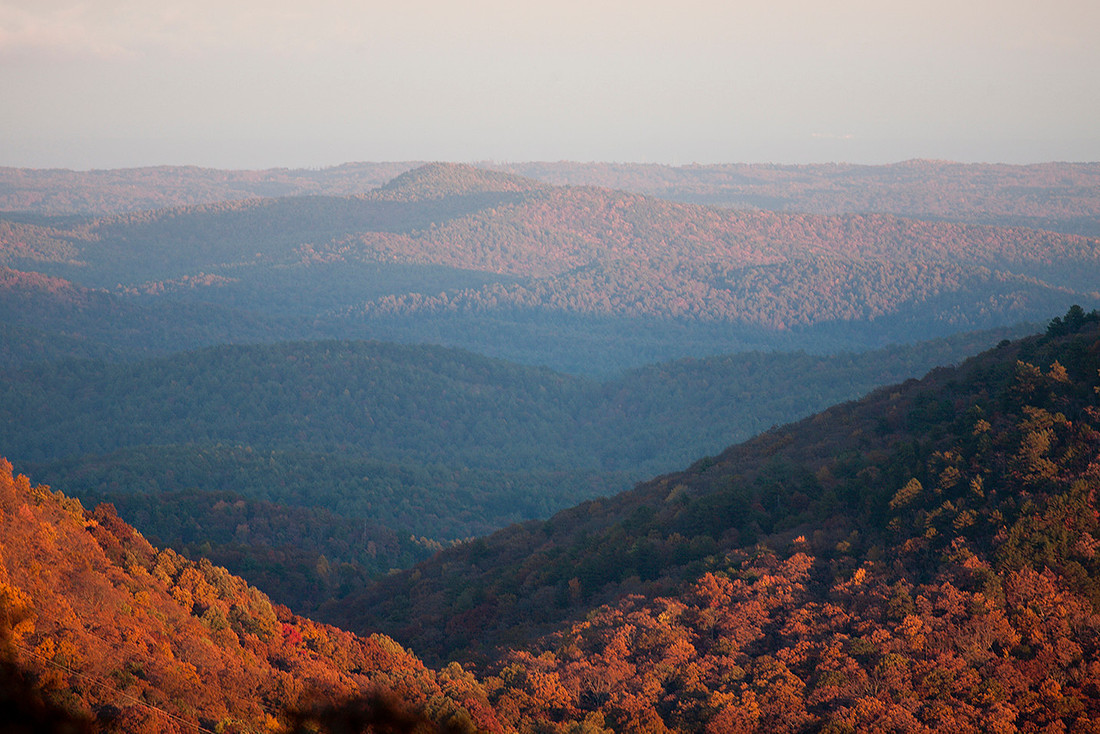
I went to bed satisfied that I’d found my fall that evening along Edmond’s Backcountry Trail in Black Rock Mountain State Park. The spectacular and dramatic landscape that was in store for our final day in the Chattahoochee would be icing on the cake.
The elevation profile for our 3rd and final hike resembled that of a crashing or booming stock market depending on which direction you happened to be taking it.
The Gorge Floor Trail ascends or descends precipitously 3/4ths of a mile to the canyon’s uppermost rim, or to the riverbed floor of Georgia’s spectacular Tallulah Gorge. Only 20 miles south on Highway 441 from Black Rock Mountain State Park, the Gorge Floor Trail within the Tallulah Gorge State Park was to be the 3rd distinctly different fall landscape that we’d hike through on our trip.
Only 100 hiking permits to access the gorge floor are issued per day, so we arose early and broke camp before dawn, so that we could arrive at Tallulah when the gates opened to be assured of getting our permits.
Upon our arrival however, a major wrench was to be thrown into the works. There would be no permits that day and consequently, no trail access due to a scheduled damn release that would fill the canyon’s bottom. Only specially permitted kayakers could access the bottom on this day. So, we had no choice but to make do with the well-manicured North and South Rim Trails and the staircase that descended most of the way down the gorge to a suspension bridge that provides a spectacularly dramatic view of Hurricane Falls. Our intended hike, if you could call a 1,200-foot vertical rock scramble a hike, would have to wait till another trip.
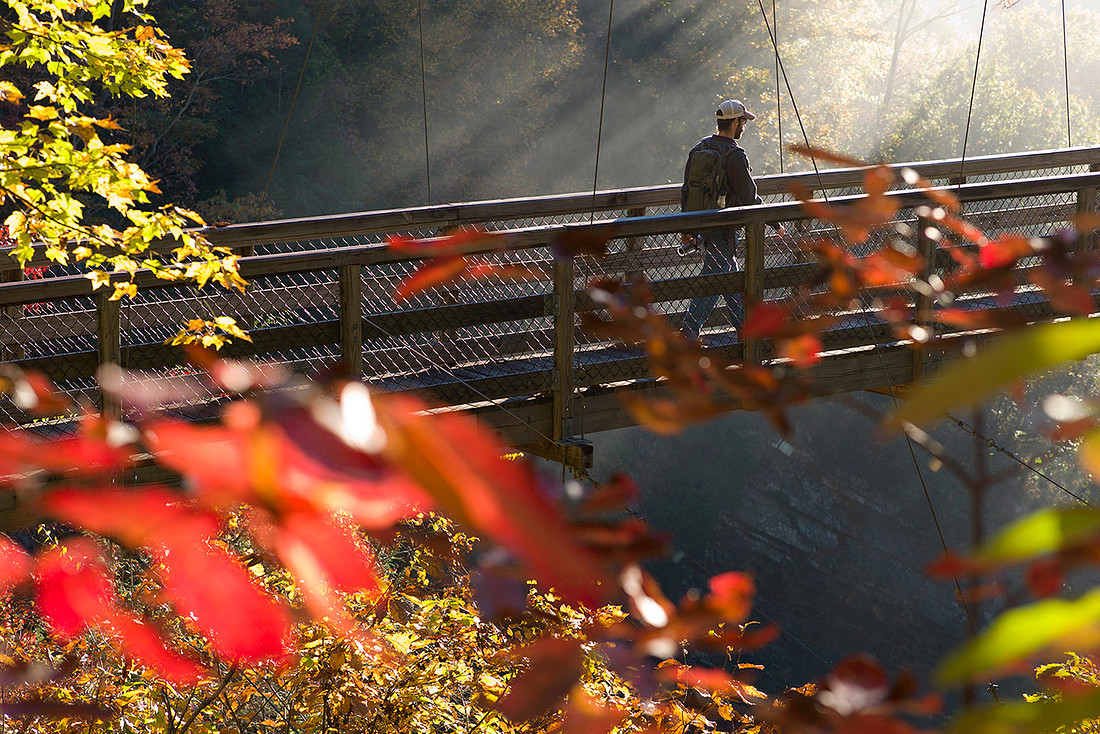
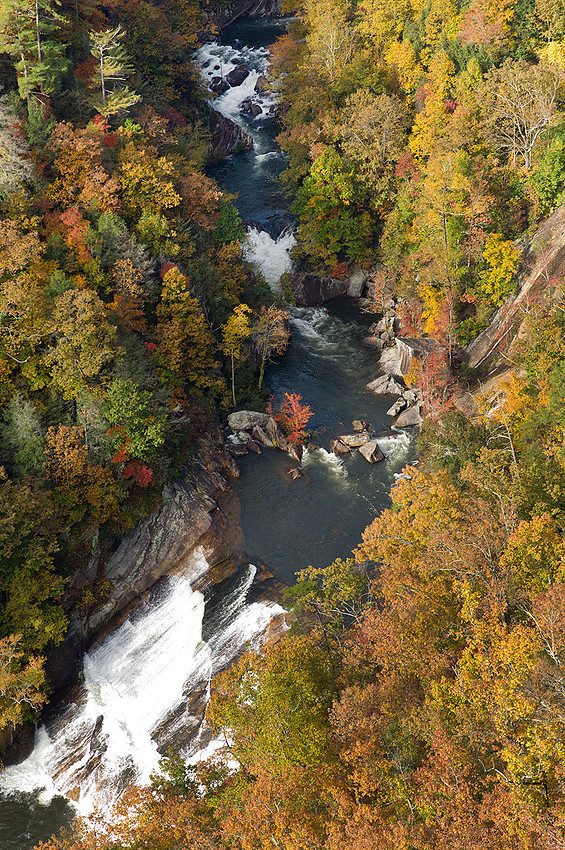
As we started down the 550 step metal grate staircase, the sun, still not yet high enough to penetrate into the deepest depths of the gorge, cast sharp shadows that sliced the canyon into two distinct halves. The lower portions, shrouded and darkened in the shadow cast by the rim of the gorge itself, contrasted sharply from the upper portions in full sun, shimmering intensely of brilliant red, yellow and golden hues.
From the suspension bridge halfway down into the gorge, the view is breathtaking. Replace the red and yellow maples with Aspens and conifers and I would swear that we were hiking in the Rockies, maybe in the Big Horns of Wyoming, or even portions of the Wasatch Range in Utah.
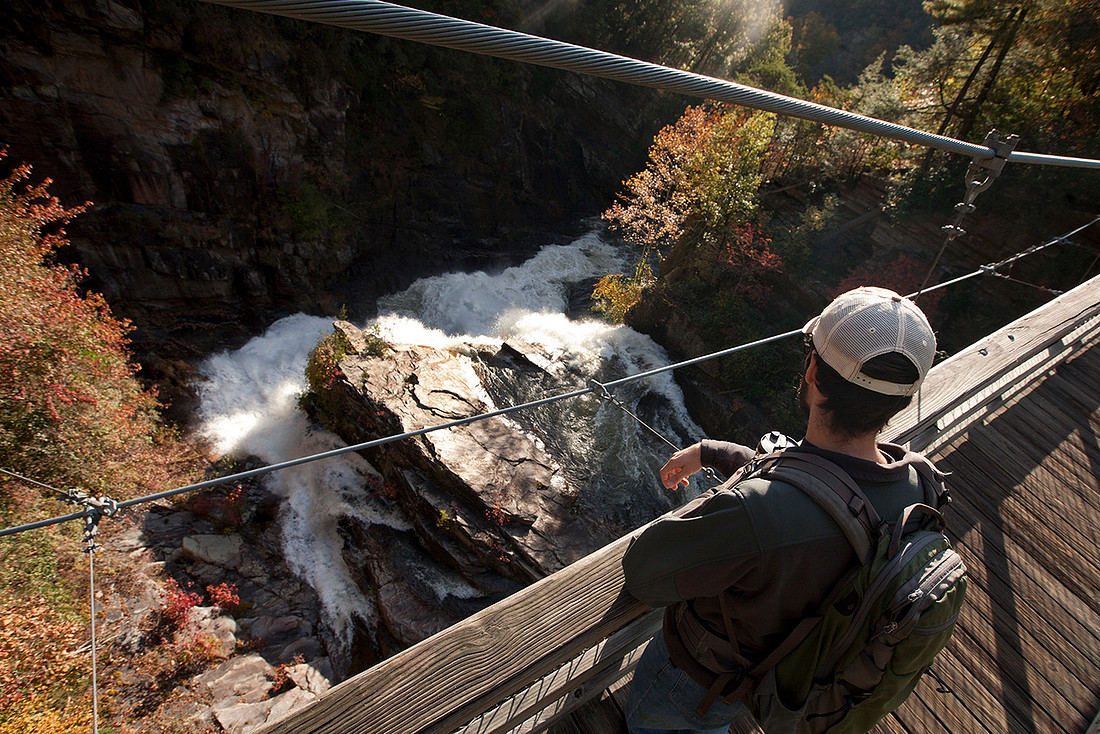 Tallulah Gorge’s 2-mile long and more than 1,000 foot earthen scar of quartzite, with its 6 plunging waterfalls coursing through it, transported me from Georgia to a place I’d never associate with the peach state, the southeast or the Appalachians. Here, Mother Nature had a flair for the flamboyant, an overly dramatic outburst of rock and water.
If the blanket of color viewed from the top of Edmond’s Trail the previous day was smoldering, then the trees that clung precipitously from Tallulah Gorge’s walls were fully engulfed in a raging fire.
In places, trees of the most intense color I’d seen thus far on the trip, clung to the most precarious of stone perches, a torrent of raging white water rushing by beneath, sun rays splintering around them in shafts of light, their leaves backlit and glowing bright yellow like fiery embers ejected from a furnace.
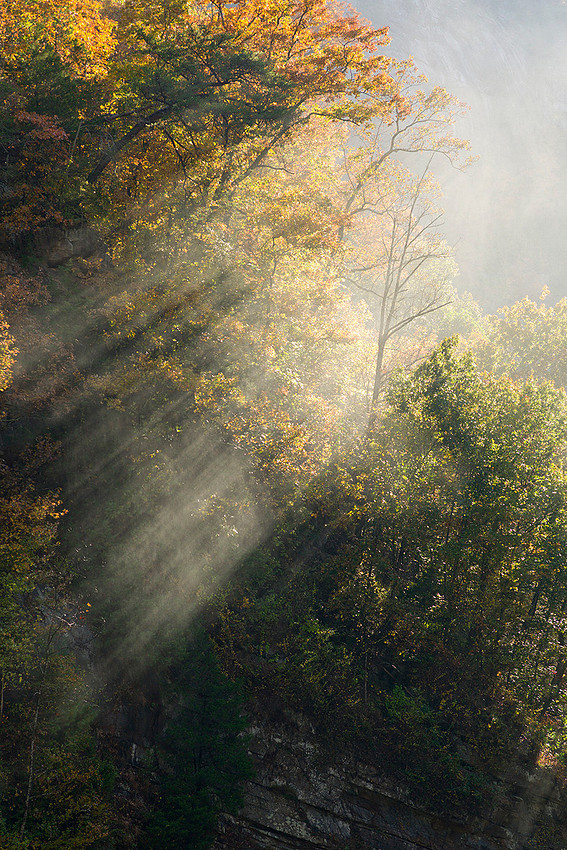
Such overwhelming views quickly suppressed my initial feelings of disappointment about not being able to hike into and out of the gorge the floor. That hike wouldn’t be going anywhere, and I knew I’d be back soon on a day when there was not a scheduled damn release that makes the gorge floor inaccessible. Besides, after three days of searching for the perfect fall color and hiking through diverse environments in the Chattahoochee, my still aching muscles would appreciate an abbreviated day.
On the short hour and a half a drive back to Atlanta, and then south, for the long stretch back to my home in north Florida, visions of the fall splendor I’d discovered in north Georgia replayed in my head.
Despite not finding the correct trailhead on our initial hike and not being able access the depths of Tallulah Gorge on day 3, I found my fall over the course of a long late October weekend in the Chattahoochee National Forest.
Fall crunched under foot as I hiked the Appalachian Trial in the cold and the wind at Nimblewood Gap. It was visible in the quaint roadside stands hawking pumpkins and squash, and in the seasonal decorative touches adorning storefronts in the Chattahoochee hamlets such as Dawson, Dahlonega, Clarksville, and Clayton. It was gloriously spread out to the horizon beneath an impeccable clear blue sky, rolling burnt orange and rust colored mountains visible from atop Edmond’s Trail at Black Rock Mountain State Park. And, it was in the early morning shafts of sunlight, fractured by bright red and yellow maples that clung precariously to the walls of Tallulah Gorge.